
Repositories
A selection of my favorite projects. Everything else lives at github.com/KHOUTAIBI.
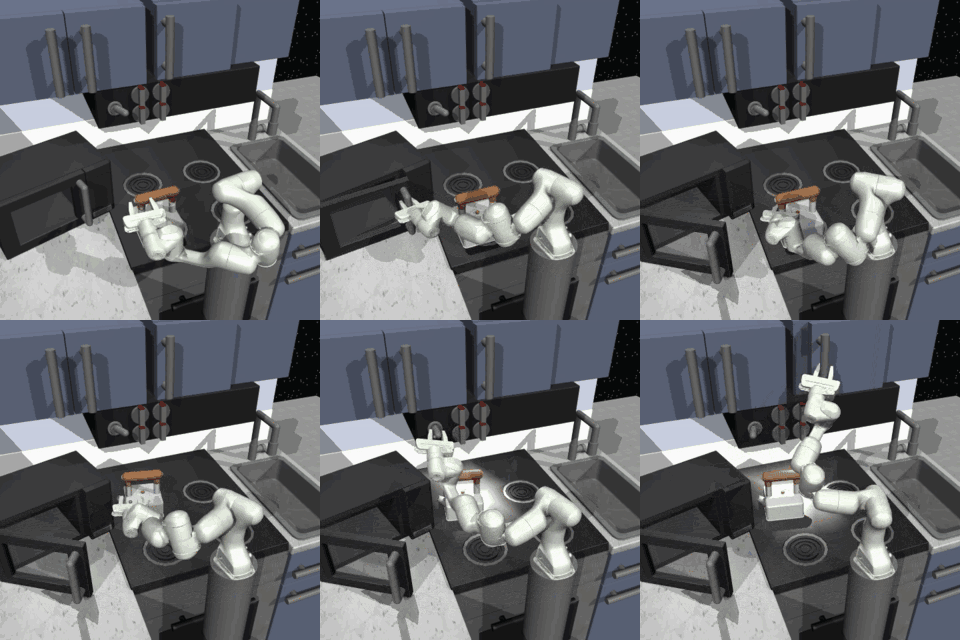
DiffusionPolicy
Reimplementation of Diffusion Policy: robot actions are generated by denoising perturbed action sequences conditioned on visual and proprioceptive observations. Includes DDPM-based policies for FrankaKitchen and PushT, plus a flow-matching variant for comparison.
- Diffusion Policy: Visuomotor Policy Learning via Action Diffusion (arXiv:2303.04137)
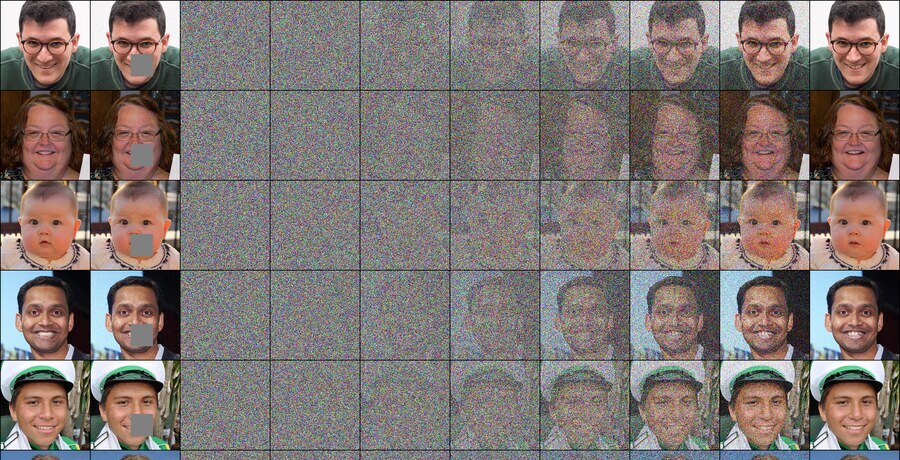
GenerativeImageModeling
Training-free guided diffusion for inverse problems in image restoration: a pre-trained DDPM/DDIM prior is steered at inference time with DPS and PiGDM guidance to solve inpainting, super-resolution, motion deblurring, and compression artefact removal.
- Diffusion Posterior Sampling for General Noisy Inverse Problems (arXiv:2209.14687)
- Pseudoinverse-Guided Diffusion Models for Inverse Problems (ICLR 2023)
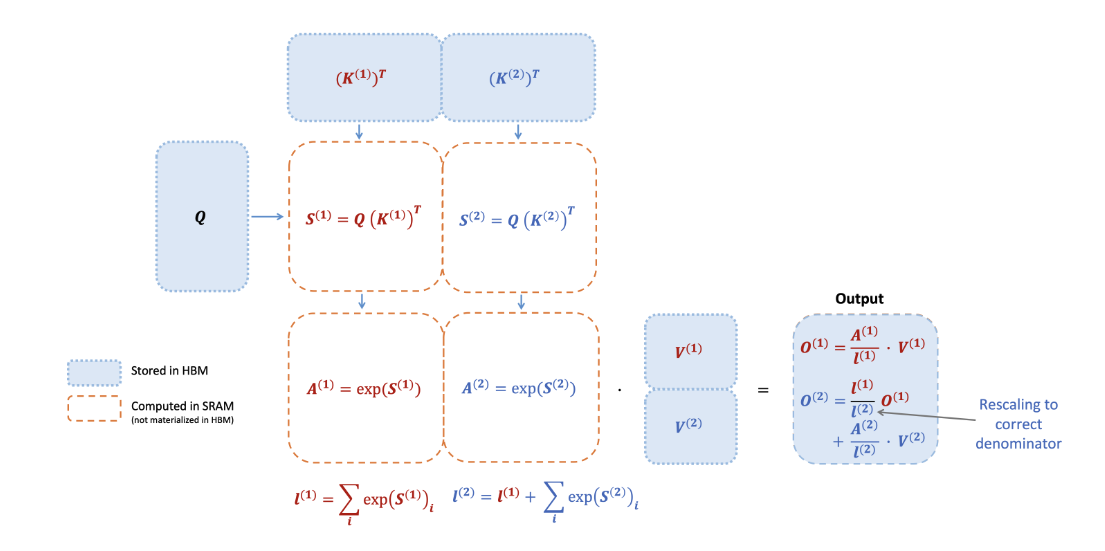
gpu_llm_flash-attention
FlashAttention-2 implemented from scratch in Triton: tiled, IO-aware exact attention with online softmax, written as custom GPU kernels and benchmarked against naive attention.
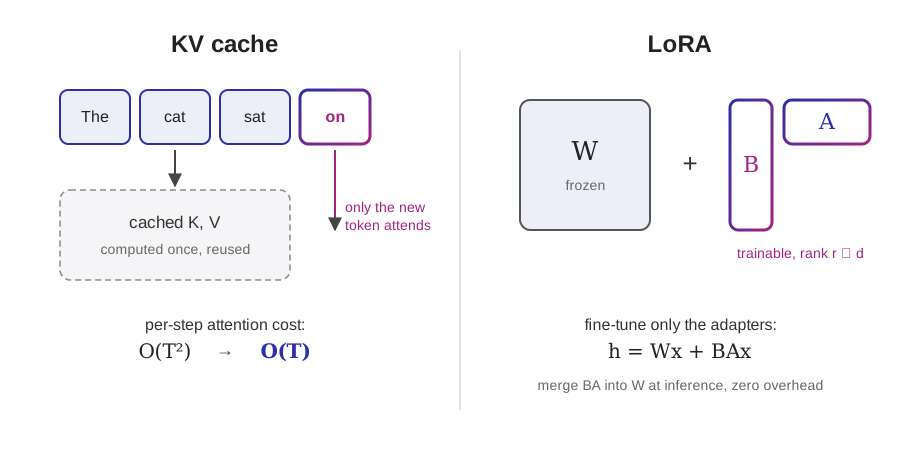
LLM-kv-cache-LoRA-efficiency
Efficient LLM inference and fine-tuning on top of Karpathy's minGPT: a KV cache threaded through the attention stack reduces per-step decoding cost from quadratic to linear, and LoRA adapters enable low-rank fine-tuning with zero inference overhead after merging.
- LoRA: Low-Rank Adaptation of Large Language Models (arXiv:2106.09685)
controlled-LLM-generation
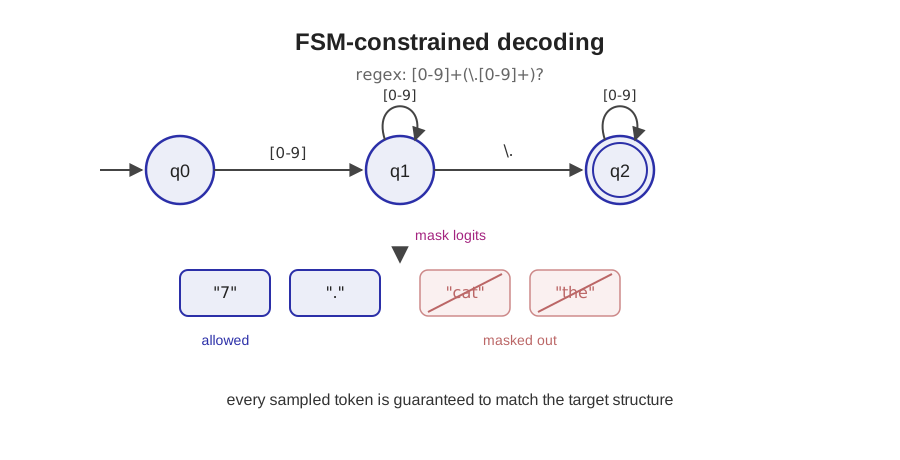
Controlling LLM outputs at three levels: regex-compiled finite state machines that mask logits so every token matches a target structure, meta-generation strategies that sample and rank multiple candidates, and iterative self-correction of generated code driven by verifier feedback and tree search.
- Efficient Guided Generation for Large Language Models (arXiv:2307.09702)
- From Decoding to Meta-Generation: Inference-time Algorithms for Large Language Models (arXiv:2406.16838)
Agentic Zork
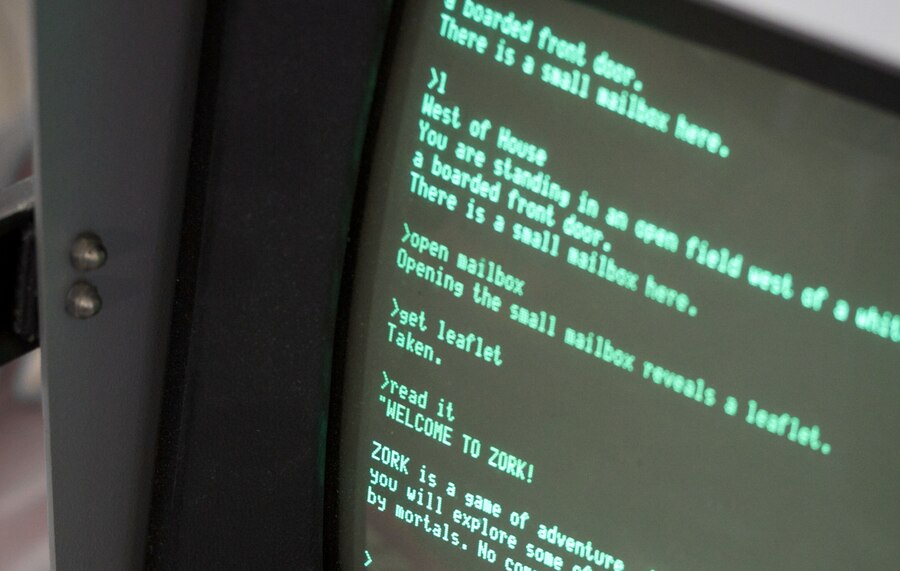
A ReAct-style LLM agent that plays classic Z-machine text adventures (Zork and 56 other Infocom-era games) through an MCP tool server: the agent reasons over room descriptions, chooses actions, and explores partially observable environments purely from text.
- ReAct: Synergizing Reasoning and Acting in Language Models (arXiv:2210.03629)
- Interactive Fiction Games: A Colossal Adventure (Jericho, arXiv:1909.05398)
- Zork (1977-1979), Massachusetts Institute of Technology / Infocom
Photo: Marcin Wichary, CC BY 2.0
View the Space